
"I invite each one of you to become a partner in India's growth story. And once again assure you of our wholehearted support."

Modi said the ease of doing business ranking improved because the government initiated reforms to end difficulties in the lives of people.

Without bringing sound governance and technical capabilities into the RBI's work, injecting new money sets the stage for a next wave of bad behaviour by banks, warns Ajay Shah.

The banking sector's credibility is on thin ice. Unless the government takes strict steps, things could get worse.

Indian bankers are fearful that going out of their way to save Jet could lead to subsequent harassment from investigative agencies.
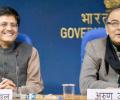
While Arun Jaitley remains part of the decision making process, Piyush Goyal, who was given additional charge on May 14, attends cabinet meetings and takes the day-to-day decisions.

Stating that a weak fiscal position continues to constrain India's sovereign ratings, Fitch said the next government's medium-term fiscal policy will be of particular importance from a rating perspective.

He said the country has witnessed a journey from indecisiveness to clarity and decisiveness.

The NCLAT said the RBI cannot restrict it from prohibiting banks from 'asset classfication' and observed that any change in this order would upset the entire resolution process of the IL&FS

A combination of demonetisation, a poorly and hurriedly implemented GST, and more recently the "botched up" lockdown of the economy to control the spread of Covid has brought the economy to its knees.

N Sundaresha Subramanian, Karan Choudhury and Shreya Jai report on the sorry condition of homebuyers who invested in Jaypee Infratech and the Amrapali group's Noida-based projects.

'In India, most funds have one or at most two platforms, but we are the only one which has four -- growth equity practice, real estate practice, a special situation and credit platform, and infrastructure.'

Delivering a public speech hours after the RBI launched a rescue act for Yes Bank on March 6, Governor Shaktikanta Das reiterated the RBI's affirmation to do whatever was needed to combat the coronavirus impact. On that day, India had only one confirmed COVID-19 infection, the World Health Organisation was five days off from declaring it as a pandemic and the financially debilitating lockdowns were not even on the horizon. Das' promise on efforts to mitigate COVID-19 impact appeared as a footnote in news reports from the event.

The failure to reform has meant that there is no buzz about job opportunities, or about urban opportunities enticing young people off the farms. And it is this failure that has contributed to the widespread disappointment that threatens to make the next general elections closer than expected, says Mihir S Sharma.

'When there is unlocking, there is demand revival.' 'This is going to be the main growth engine in this kind of an economic scenario.'

Of the seven surveys presented under Modi govt, predictions of three were quite close to the actual GDP growth rate, one saw the base year change in between, but the last three were way off the mark.

The trio, 'twin shocks' of demonetisation and GST, 'twin balance sheet' problem that has been weakening India's banking system and the 'twin deficit' problem will continue to challenge economic management and performance in the year ahead, says Shankar Acharya.

'If India can only grow at 5%, why bother spending time on the country?' asks Akash Prakash.

While Waryam Singh was a non-executive director at HDIL, he is listed as one of the promoters of the company and had relations, including shareholding, with several other entities controlled by the Wadhawans, the HDIL founders.

'There has been far too much overconfidence about the size and composition of the Indian consumer economy,' notes Mihir S Sharma.
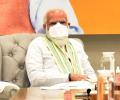
'I would like to convey the message to your readers that the prime minister himself is directly seized of the situation on the ground. He periodically reviews the situation on the ground and how it is moving forward, taking inputs from economists, business leaders, chambers of commerce.'

'We all wanted a strong Centre with a decisive mandate from the people, to allow them to take bold decisions.'

Srei Infrastructure's vice-chairman -- and former Assocham president -- Sunil Kanoria discusses the Kanoria businesses and his impression of the Modi government with Ishita Ayan Dutt and Namrata Acharya.
'There are deeper, underlying, forces at work and we need institutional arrangements to guard against them.'

Six months into his new role, Vishal Wanchoo, president and chief executive officer, GE, South Asia, speaks to Jyoti Mukul about how its horizontal business lines of additives and digital are playing across its verticals.
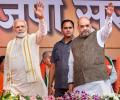
It is worth reconsidering if this fascination with either having a single party majority or Modi's leadership or, indeed, both, is such a great idea for India, says Udit Misra.

Total net debt-equity ratio improves for third consecutive year, while investment in new projects hits a 10-year low, says Krishna Kant.

'The new government will have to contend with slowing economic growth, weak private investment, anaemic exports and vulnerable external imbalances, a stressed financial system, mounting fiscal pressures (including high government debt-to-GDP ratios) and an exceptionally bad employment situation,' says Shankar Acharya, former chief economic adviser to the Government of India.

'Gloom is nowhere in sight, with healthy foreign exchange reserves, a strong rupee, healthy tax collections, corruption and crony capitalism under check,' argues Gopal Krishna Agrawal.

Shaktikanta Das said in Washington, DC, that there was nothing sacrosanct about the 25 bps rate cut and that monetary policy could be well served by calibrating the size of the policy rate to the dynamics of the situation, and the size of the change itself could convey the stance of policy.
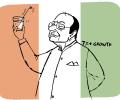
'The attempt to build a negative narrative about India's economic performance is disingenuous.' 'For the investors as well as the targeted beneficiaries of welfare schemes, the ground reality is very different,' argues Rajiv Kumar, vice-chairman, NITI Aayog.

India has a unique window of opportunity to effectuate long-lasting structural change in its banking sector, says Riju Agrawal.

Bankers seem to be pleased with the government for keeping its promise of not interfering in operational matters, but are apprehensive about the intense scrutiny of their functioning.

'The BJP has shown signs lately of returning to its trader mindset.' 'Several strong emotions get meshed in this: Nationalism, protectionism, mercantilism, and arrogance,' points out Shekhar Gupta.
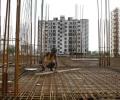
Keki Mistry, vice chairman and CEO, HDFC tells Joydeep Ghosh and Chirag Madia that unlike some other players it never went for excesses and never took unreasonable risks.
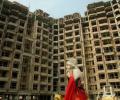
A decline in the real estate sector, rising debt and the company's alleged involvement in 2G scam caused damage to the business and its image.

There are also signs that the private sector investment cycle is slowly coming back, as capacity utilisation figures across industry continue to slowly creep up. A pickup in investments will front load profitability, says Akash Prakash.
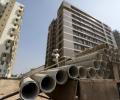
According to property consultancy firm Knight Frank, only 19 states and UTs have a functional portal in place, that too with a lot of information dissymmetry across data points

Farm loan waivers should not be regarded as expenditure but as incentive and investment, argues B S Raghavan, the distinguished civil servant.

'The government is sincerely working on employment generation. Unfortunately, they are depending on these people from Harvard. Their wrong policies are killing jobs. The government has to come out of the Western framework on which they depend upon a lot.'
